How Long Does CBD Stay in Your System? | Elevated Montana
CBD can remain in your system for several days, but timelines vary widely based on the product used, frequency, dosage, and individual metabolism. Most standard drug tests do not test for CBD. They test for THC metabolites. However, trace amounts of THC found in some CBD products, including mislabeled or full-spectrum options, can still lead to a positive test.
Because no CBD product can guarantee the complete absence of THC, anyone subject to workplace or random drug testing should understand that using CBD always carries some level of risk, even with lab-tested products.
Elevated Montana prioritizes transparency first and helps customers understand those risks so they can make informed decisions.
Before diving deeper, it helps to understand a few core points about how CBD is processed, what drug tests actually detect, and why product type and personal factors play such a large role in testing outcomes.
- CBD clearance varies widely: Some people clear cannabinoids within days, while frequent or high-dose use can extend detectability.
- Drug tests detect THC metabolites, not CBD: Any positive result is tied to THC exposure, not cannabidiol itself.
- Product type matters:
- Inhaled products tend to leave the body faster
- Edibles and tinctures may linger longer
- Topicals generally do not enter the bloodstream in detectable amounts
- No CBD product is risk-free for drug testing: Even CBD isolate products may carry trace THC due to labeling or manufacturing inconsistencies.
- Individual factors matter: Hydration, metabolism, body composition, and dosage all influence clearance time.
For Montanans navigating CBD use alongside workplace or random drug testing, uncertainty can be stressful. Elevated Montana prioritizes transparency and education, helping customers understand product testing, Certificates of Analysis, and personal risk factors before they ever make a purchase.
In the sections that follow, we break down what actually happens in your body when you take CBD, why some people still fail drug tests, and how to think about risk realistically. Keep reading to understand the science, the limitations, and how to make informed decisions that protect what matters most.
What Really Happens When You Take CBD
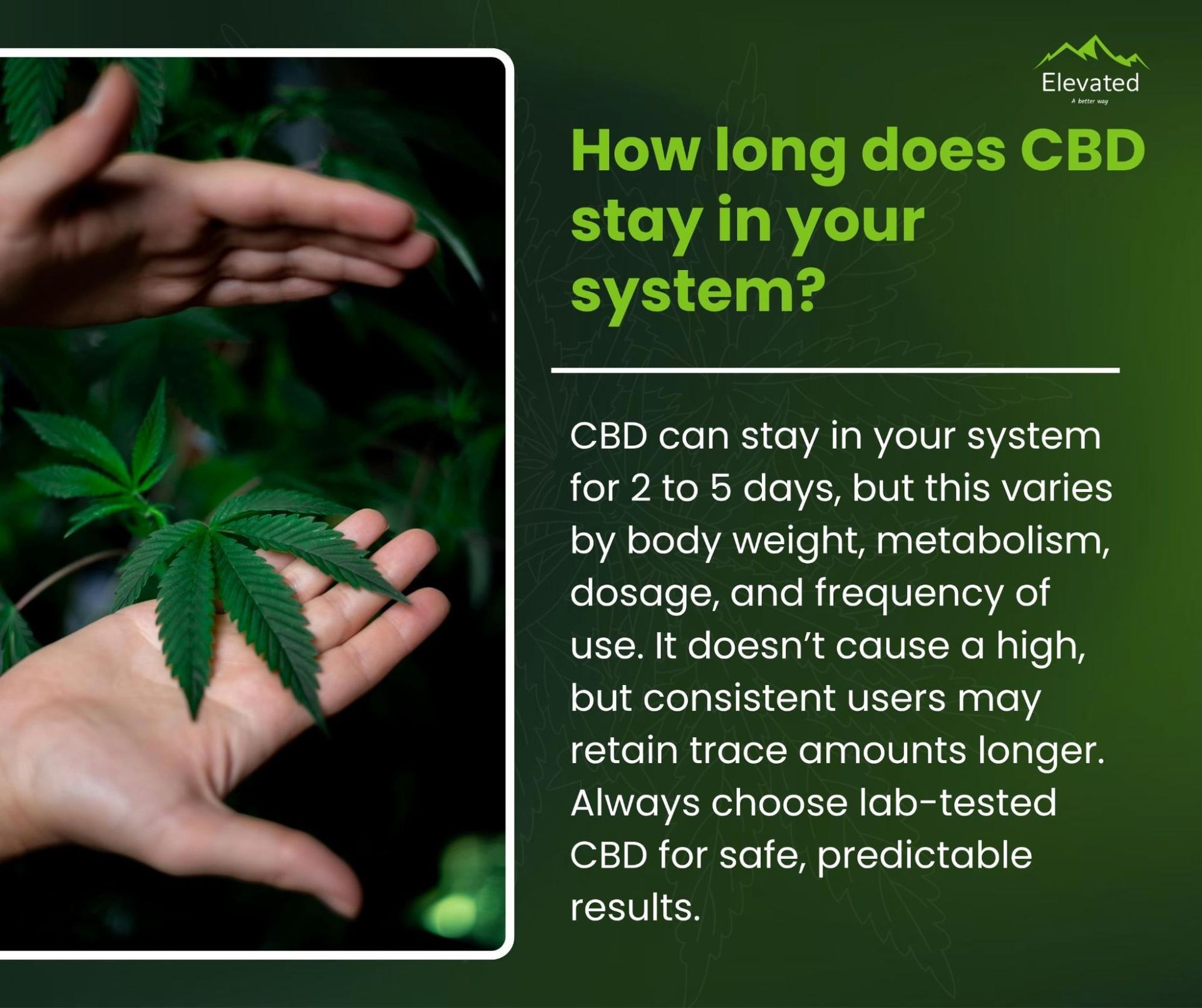
Here is the simple truth. Your body processes CBD much like anything else you eat, drink, or inhale. It absorbs some, metabolizes what it can, and eventually clears the rest over time.
When you take CBD, whether as a gummy, tincture, capsule, or vape, it enters the bloodstream and interacts with the endocannabinoid system. This system plays a role in regulating mood, sleep, pain, stress, and overall balance. CBD does not act like an on or off switch. Instead, it influences how this system functions, which is why effects can feel subtle and vary from person to person.
Because everyone’s body chemistry and metabolism are different, the amount of time CBD and related compounds remain in the body can vary widely.
What Happens Inside the Body
- Absorption: CBD enters the bloodstream through digestion when consumed as edibles or tinctures, or through the lungs when inhaled. The method of use affects how quickly CBD is absorbed and how long it may remain detectable.
- Distribution: CBD is fat soluble, meaning it can be stored temporarily in fatty tissue. People with higher body fat or slower metabolisms may retain cannabinoids longer than others.
- Metabolism: The liver breaks CBD down into smaller compounds. During this process, any trace cannabinoids present in the product, including THC if present, are also metabolized.
- Elimination: CBD and its metabolites are eventually eliminated through urine and stool. For some people this may happen within a few days. For frequent or high-dose users, trace compounds can remain longer.
While CBD itself is not intoxicating and is not what drug tests look for, products that contain even small amounts of THC can introduce risk. That is where most confusion and concern around testing begins.
At Elevated, we focus on transparency and education. Every CBD product we carry is lab tested and Montana verified, and our team helps customers review testing information so they understand what they are buying. The goal is not to make promises, but to provide clear information so you can make decisions that fit your needs and risk level.
Does CBD Show Up on a Drug Test?
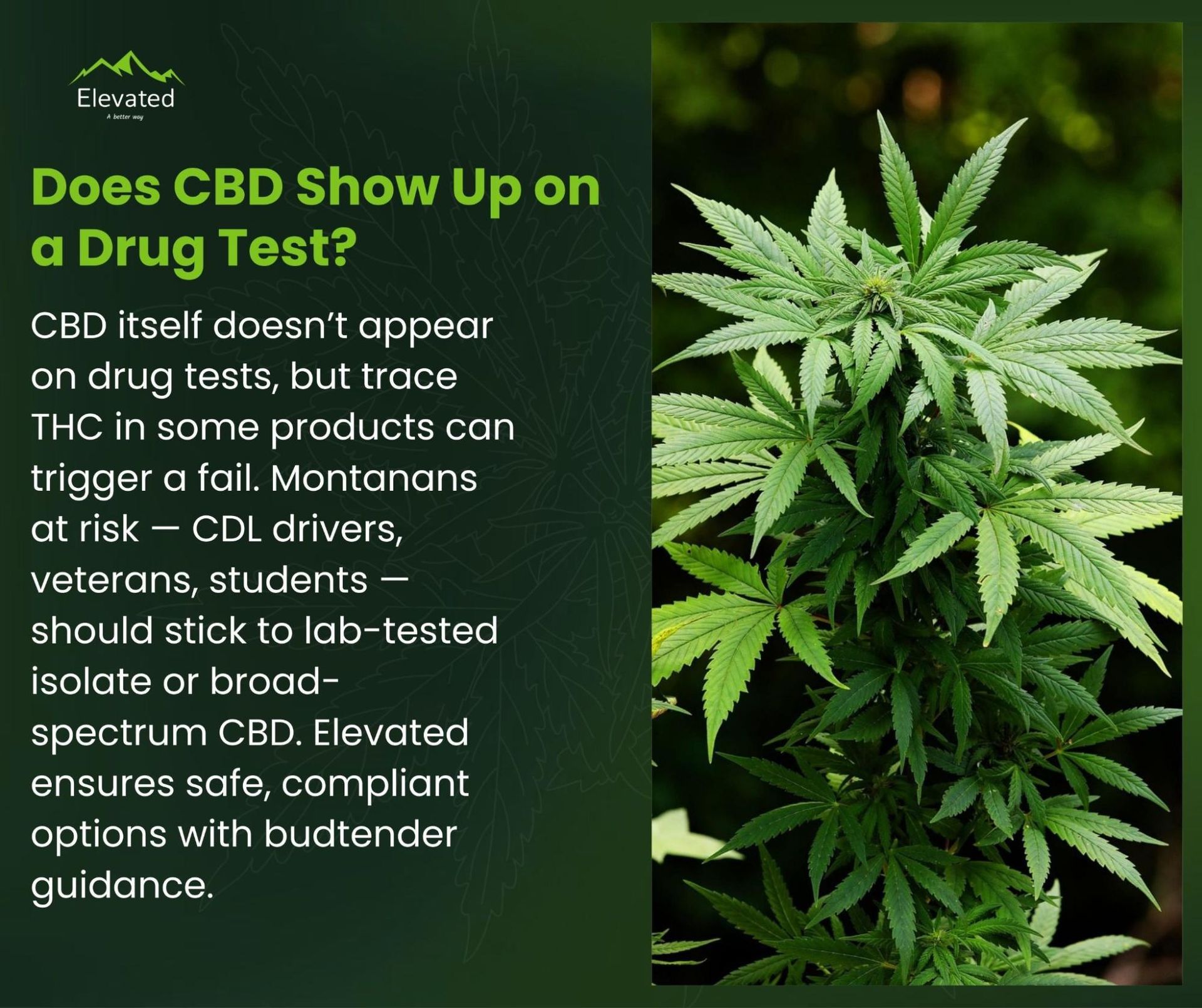
Standard drug tests do not screen for CBD itself.
Workplace drug tests, including urine, saliva, blood, and hair tests, are designed to detect THC metabolites, not cannabidiol. The primary compound labs look for is THC-COOH, which is produced when the body processes THC, the psychoactive compound found in marijuana.
This is where confusion often begins.
Many CBD products, including some labeled “THC-free,” may still contain trace amounts of THC. Full-spectrum products are legally allowed to contain up to 0.3 percent THC, and even broad-spectrum or isolate products can carry trace amounts due to labeling inconsistencies or manufacturing cross-contamination.
While these trace levels are not enough to cause intoxication, they can accumulate in the body over time. With regular or daily use, THC metabolites may build up to levels that are detectable on a urine test.
This is why many people are surprised when they fail a drug test after using CBD and say, “I only took CBD.”
In most cases, failed tests are not caused by CBD itself. They are caused by unintended THC exposure combined with inconsistent regulation and unclear labeling across the CBD industry.
Understanding this distinction is critical for anyone who is subject to workplace or random drug testing.
How Long CBD Really Stays in Your System: The Science
If you have searched this question online, you have probably seen answers ranging from a few hours to several weeks. That wide range exists because there is no single timeline that applies to everyone. How long CBD and related compounds remain in the body depends on several individual and product-specific factors.
Key Factors That Affect How Long CBD Stays in Your System
How much you take
Larger doses and more frequent use increase the amount of CBD and other cannabinoids your body must process. Because CBD is fat soluble, repeated use can lead to temporary buildup in fatty tissue.
How you take it
The method of consumption plays a role in absorption and elimination time.
- Inhaled products are absorbed quickly and generally leave the body sooner
- Edibles and tinctures are processed through digestion and may remain longer
- Topicals typically stay localized on the skin and are unlikely to enter the bloodstream in detectable amounts
Your metabolism and body composition
People with slower metabolisms or higher body fat percentages may retain cannabinoids longer than those with faster metabolic rates.
Frequency of use
Occasional users may clear cannabinoids more quickly than daily or high-dose users. Repeated exposure increases the chance that trace compounds remain detectable for longer periods.
Product purity and formulation
Products containing THC introduce additional variables. Full-spectrum products may extend detection windows due to THC metabolism. Even products marketed as isolate or THC-free can carry trace amounts, depending on manufacturing and testing standards.
What This Means in Practice
For some individuals, CBD-related compounds may clear within several days. For others, especially frequent users, trace compounds can remain longer. There is no timeline that can guarantee when someone will test negative.
Because drug tests detect THC metabolites rather than CBD, any product that contains or is contaminated with THC carries potential risk. For individuals subject to drug testing, no form of CBD can be considered completely risk free.
Rather than relying on timelines, the safest approach is understanding your testing requirements, reviewing lab reports carefully, and deciding whether CBD use aligns with your personal risk tolerance.
Why Some People Still Fail Tests (Even with “THC-Free” Products)
This is where things get unfair, and why so many Montanans feel frustrated.
You do your homework. You buy something labeled “THC-free.” You take it responsibly, never feel high, and assume you’re in the clear. Then a week later, the lab calls, and suddenly your career, your reputation, and your peace of mind are on the line.
Here’s the hard truth: not every brand is as honest as it looks.
1. Labeling Gaps & Industry Loopholes
In the U.S., there’s still no federal standard for CBD testing or labeling. That means two products sitting side by side on a shelf, both saying “THC-free”, could be completely different.
A 2017 JAMA study found that nearly 70% of online CBD products were mislabeled, often containing detectable THC. Even a trace amount can accumulate with daily use and trigger a positive urine result.
2. Manufacturing Cross-Contamination
Even when a product starts as THC-free, it can pick up trace amounts during processing if it’s made in a facility that handles full-spectrum extracts. Think of it like baking in a shared kitchen, one small mix-up, and suddenly you’re dealing with residue.
3. Workplace Zero-Tolerance Policies
Many Montana employers maintain zero-tolerance drug policies that do not distinguish between hemp-derived THC and marijuana use.
Even when a CBD product is legal under state and federal law, a positive THC result can still violate workplace policy. This affects workers across many fields, including healthcare, transportation, construction, and public service roles.
4. Detox Myths and False Promises
Online advice often promotes quick fixes such as detox drinks, excessive hydration, or sauna use. There is no scientific evidence that these methods reliably eliminate THC metabolites faster.
The only proven factors that influence clearance are time, individual metabolism, and total exposure. No product or method can guarantee rapid or complete removal of THC from the body.
Because no one should lose a job over misinformation. Not here, not in Montana.
How to Protect Yourself Before a Test
Here is the most important thing to understand upfront. If you are subject to workplace, DOT, medical, or random drug testing, the only way to completely avoid risk is to avoid CBD products altogether. No CBD product can guarantee the absence of THC, even when lab tested.
That said, understanding how risk works can help you make informed decisions long before a test is scheduled.
1. Understand Timing Limitations
Many people assume stopping CBD use a few days before a test will eliminate risk. While some compounds may clear within days for certain individuals, there is no reliable timeline that applies to everyone.
For frequent or higher-dose users, trace THC exposure can remain detectable longer. Because metabolism, body composition, and product variability differ from person to person, timing alone should not be relied upon as protection.
If a drug test affects your job, benefits, or education, avoiding CBD entirely is the safest option.
2. Support Natural Metabolism, Not Detox Myths
Hydration, regular movement, and balanced nutrition support normal metabolic processes, but they do not act as detox solutions. No drink, supplement, or routine can reliably speed up the removal of THC metabolites.
Time and total exposure are the only factors shown to affect clearance.
3. Know the Risk by Product Type
- Topicals: Generally low risk because they are unlikely to enter the bloodstream in detectable amounts
- CBD isolate: Marketed as THC free, but still not risk free due to possible contamination or labeling inconsistencies
- Broad-spectrum products: Lower THC exposure than full-spectrum, but still variable
- Full-spectrum products: Contain THC and carry the highest risk for testing environments
If drug testing is part of your life, no CBD product can be considered fully safe.
4. Review Lab Reports Carefully
Reputable products provide Certificates of Analysis from third-party labs. These reports help reduce uncertainty, but they do not eliminate risk. Lab results reflect a sample from a batch, not an absolute guarantee.
Understanding how to read these reports is more important than relying on marketing claims.
5. Buy From Licensed, Regulated Sources
Licensed Montana dispensaries are subject to stricter testing and compliance standards than online sellers or convenience stores. Buying local reduces the chance of mislabeled products, but it does not remove testing risk entirely.
6. Talk With a Budtender Before You Buy
While we do have menus, Elevated’s team focuses on conversation and education. Budtenders can help explain product types, testing information, and potential risks based on your situation.
Sometimes the best protection is not a product choice, but deciding whether CBD use fits your personal risk level at all.
Stay Calm, Stay Informed, Stay Elevated
If there’s one thing to remember, it’s this: CBD doesn’t have to feel uncertain. Most fear around testing or legality comes from confusion, and that fades fast once you have real facts, trusted products, and people who care.
For Montanans, CBD isn’t a fad, it’s a way to manage pain after a long day, ease nerves before a shift, or wind down after years of hard work. It’s about taking care of yourself, honestly and responsibly.
That’s where Elevated Montana comes in. We’ve built our reputation on clarity, compliance, and compassion. Every CBD product we carry is tested by a state-trusted lab for purity and 0.00% THC, with certificates available for you to check yourself. While we do have menus, our budtenders go beyond them, explaining isolate vs. full-spectrum, testing thresholds, and safe timing before screenings.
Peace of mind matters here. Losing a job over a mislabeled product shouldn’t happen. Our goal isn’t just to sell CBD, it’s to give you confidence to use it wisely and without worry.
So the next time you reach for a tincture, gummy, or topical, do it knowing your relief and your reputation are in good hands. Because wellness in Montana isn’t about trends, it’s about trust, transparency, and taking care of your own.
Stay calm. Stay informed. Stay Elevated.
Disclaimer
The information provided in this blog is for educational purposes only and is not intended as medical advice, diagnosis, or treatment. Cannabis affects everyone differently, and individual results may vary. Always consult a licensed healthcare provider before using cannabis products, especially if you have a medical condition, are pregnant or nursing, or are taking prescription medications.
All cannabis products sold by Elevated are tested by state-licensed Montana laboratories for quality and compliance. Must be 21+ to purchase recreational cannabis, or a registered cardholder for medical products. Consume responsibly and in accordance with Montana state laws.
References
- Bergamaschi, M. M., et al. (2011). Safety and side effects of cannabidiol, a Cannabis sativa constituent. Current Drug Safety, 6(4), 237-249. https://doi.org/10.2174/157488611798280924
- Bonn-Miller, M. O., Loflin, M. J. E., Thomas, B. F., Marcu, J. P., Hyke, T., & Vandrey, R. (2017). Labeling accuracy of cannabidiol extracts sold online. JAMA, 318(17), 1708-1709. https://doi.org/10.1001/jama.2017.11909
- Huestis, M. A. (2007). Human cannabinoid pharmacokinetics. Chemistry & Biodiversity, 4(8), 1770-1804. https://doi.org/10.1002/cbdv.200790152
- Spindle, T. R., & Vandrey, R. (2021). Pharmacokinetics of cannabinoids in humans. Handbook of Cannabis and Related Pathologies, Vol 1, Scientific Press.
- U.S. Food and Drug Administration. (2024). Hemp-derived CBD consumer update. FDA.gov.
- U.S. Department of Labor. (2023). Drug-testing policies and workplace standards: Hemp and CBD. dol.gov.
Recent Posts